The Familiar Rhythm of Festival Mornings
The festive season, spread over these months, reaches its climax with Diwali. As in every year, it leads me down memory lane – the lanes of my mohalla.
We walked those lanes on every festival, watching the aangans of every house freshly smeared with sada (सडा), cow dung and water, and the verandas where the elders sat to watch the celebrations go by.
Festival mornings were invariably a rush: an early bath, a dash to the temple, and greetings for everyone we met on the way. In a place where everyone knew everyone, there were a great many of these greetings. People from those lanes would give us compliments on our attire and we would beam at them with pleasure.
For us children, these days brought the joy of festivities, yummy food, new clothes and holidays!
Evenings That Kept Us Spellbound
Schools in our town began in early July, and so did the festive season, with Shravan and major occasions like Raksha Bandhan, Pola, Ganapati, Navratri, Dussehra, Kojagiri and Diwali lined up ahead. The first semester was always the most attractive, what with so many holidays and so much excitement in the air.
 Some of the festivals were personal, but most belonged to the mohalla and the community. It was as if a festive energy coursed through the whole place during this season.
As Shravan led the season, temples were decorated with jhankis in the days before Janmashtami, and people thronged to see them, delighting aunties, dadis and uncles with the sights on display. In the pre-TV era, it was these evenings that kept us occupied and amazed. We looked forward to every festival with equal vigour.
When Bullocks Were the Pride of the Town
Mine was largely a farming town, and Pola was one of its biggest celebrations. It was a day when farmers and their families honoured the bullocks that worked alongside them through the agricultural seasons.
My family was one of many such families. My father was particular that we followed every ritual properly, and we did, more out of the pleasure we found in them than out of fear of the elders.
What excited us young siblings was the day of invitation. We accompanied Om Bhau, who looked after the cattle and milked them daily, to invite the chosen pair of bullocks from the farm. He called out to them aloud: “आज आवतन घ्या, उद्या जेवायला या.” (Take the invitation today, come to dine tomorrow.) And we repeated it after him.
The formality of that invitation made us realise the kind of honour extended to the animal.
The day of Pola belonged to the farmers, who displayed their decorated pairs of bullocks with pride while the townspeople came to see them. At the fair, we did not know that memories were being made: the sound of bells, the display of toys, the magnificence of the animals, the pride of the owners, the press of the crowd, the colours of the decorations.
At home, the women waited for the pair to return and welcomed them with aarti and sweets. Father beamed with happiness as he looked at the pair. We were all struck by the serenity of those animals.
The next day was Tanha Pola, the children’s Pola, which was pure fun. All the children from the mohalla gathered with decorated toy bullocks for a competition. Some brought huge wooden bullocks, with lifelike eyes and painstakingly crafted decorations. We watched them with wonder and envy.
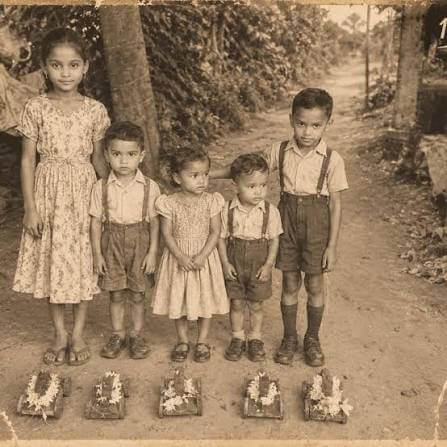
With our reused decorations and puny toys, none of us siblings ever won, yet it always ended on a happy note. Since afterwards we went from house to house in the mohalla for a ‘poli’, a penny, and every house gave each of us one. With our pockets heavy and jingling, we felt rich that one evening.
Grand Idols and Childhood Dreams
Pola led to the Ganapati and Navratri celebrations. We looked forward to the Ganpati idols taking shape at the local artisan’s house. For Durga, we marvelled at the artists who travelled from distant towns in Bengal to shape huge idols from straw, mud and paint, a process that took months.
During those days we hopped from pandal to pandal across the town and attended aarti at the pandal of our own mohalla. The pandals competed for bigger footfalls, each trying to lure visitors with towering idols, storytelling, decorations and cultural events. To top it all came the lucky draws, with prizes ranging from household gadgets to scooters and cycles. Such prizes were coveted in the pre-liberalisation era.
We children talked non-stop about what was on offer. It was every child’s dream to win one and gift it to our mother. Of course, despite dreaming of it every season, I never won a single prize.
A Celebration of Shared Joy
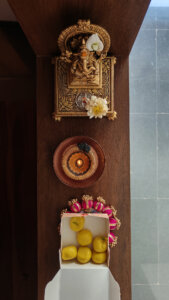 What made those days beautiful was how effortlessly they connected the community. On Dussehra, everyone in the mohalla visited every home, without pausing or stopping, until they had met all their friends and elders. Everyone joked about how expensive gold had become while offering shami leaves as gold to elders and friends, and somehow no one got tired of it!
The next few days were a flurry of cleaning the house, sometimes painting it ourselves, buying clothes, choosing rangoli colours and decorating. We got to buy only two pairs of clothes a year, one for our birthday and one for Diwali, so the excitement was enormous. Women got busy preparing delicacies, the aroma engulfing the whole house, and we children eyed the food, unwilling to wait.
And then came Diwali.
The Excitement of Belonging
 Each day of Diwali started with an early morning visit to the temple. Women, children and the elderly gathered in their finery for aarti and darshan. The cheerful chatter, the greetings, the bells, the aarti and the sunrise afterwards made every day feel like a fresh start.
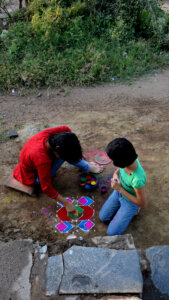
On the way back, we admired the aangans decorated with colourful rangolis. Lighting diyas was a personal ritual, but admiring the rangolis was a shared pleasure.
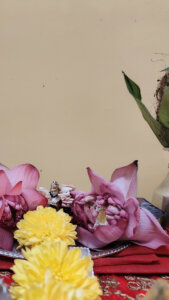
The day was spent with a series of poojas, a sumptuous lunch, an elaborate rangoli drawn before the pooja began, and the house decorated with marigold flowers and mango leaves. Excited about the diyas and firecrackers, we got ready in our newest clothes for Laxmi Poojan.
Among the well-wishers who joined us was Narayan Mama, an elderly mason who had built our house decades ago. Since then he had considered it his duty to be present at Diwali, keeping an eye on us children as we dgleefully lit our firecrackers.
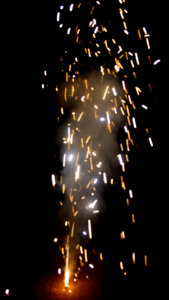 Our pooja started at dusk, so we soon ran out of crackers. It did not dampen our spirits, though. We looked forward to the bigger crackers our neighbours would light a little later. It was a borrowed pleasure which felt totally our own.
Together Through the Year
Beyond these months of celebrations, the same spirit of togetherness extended to other occasions throughout the year. Whether it was Akshaya Tritiya, or Holi every festival demanded visits to extended family and friends for snacks, meals and greetings. We gladly obliged, relishing the delicious food made specially for each festival.
The town and the mohalla celebrated all festivals, small and big, together. Women went with friends to gardens or farms for an Amla Navami picnic. On Sankranti, they invited one another home, exchanging small gifts and offering sweets.
On Rangpanchami, men, women, girls and boys roamed in groups with colours and water. In my mohalla, the women of one particular community chased the men with cloth whips, while the men tried to colour them and dodge the blows. For us children, oblivious to the roughness of the tradition, it was a delight to watch.
Even people who lived alone were visited, by unwritten rule. No one was left alone at a festival.
The Past That Lives in Our Present
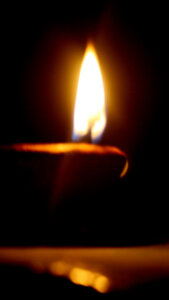 I live in a city now, and the colours of the festivals have changed. Families have grown smaller and the community more distant. Greetings arrive as messages, and rangolis are admired through Instagram posts and WhatsApp statuses rather than by walking down a lane lined with them.
Yet on festival mornings I still wake early, go to the temple, and light the diyas at home. I still make the sweets, and every one of them tastes of a kitchen that is no longer mine. Somewhere beneath the quiet, I can still hear the bells of that mohalla. The festivals I celebrate today are shaped by the ones I grew up with, and every ritual carries an older one inside it. Nostalgia does not stop me from celebrating. It is what gives the celebration its depth.
The mohalla is far behind me now, yet every festival morning, it walks with me to the temple.